
Online Consultations by prior appointment - Monday – Saturday: 1:00 PM – 3:00 PM & Sunday: 3:00 PM – 5:00 PM

Asha's Dr Smile
Advanced Laser & Cosmetic Dental Studio
Online Consultations by appointment
Monday – Saturday: 1:00 PM – 3:00 PM
Sunday: 3:00 PM – 5:00 PM
Microscopic Dentistry in Tripunithura: Microscopic vs Conventional Root Canal Treatment
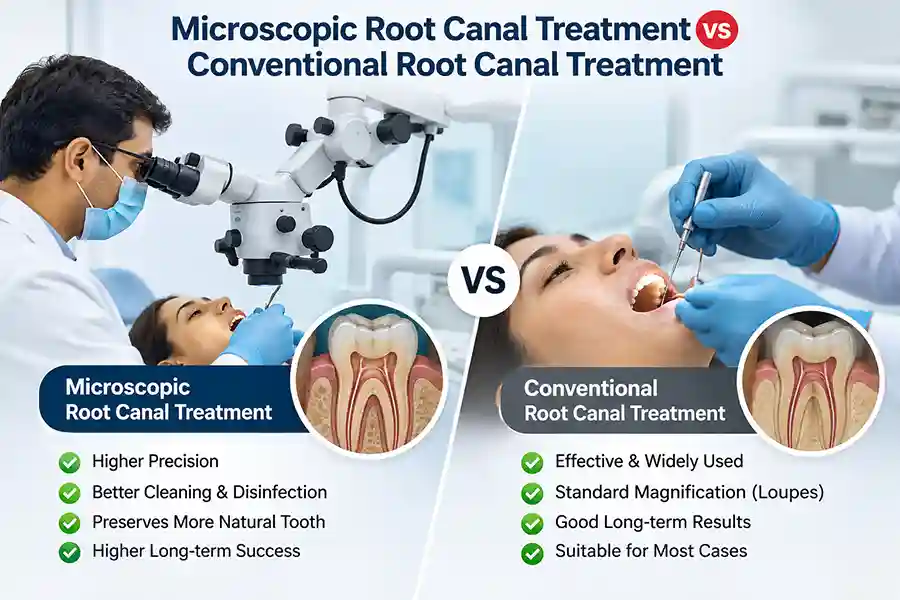
If your dentist says you need a root canal, you probably have two questions. Will it hurt, and is there a better way to do it? If you’re searching for a dental clinic in Tripunithura, the second question is worth asking, because not every root canal is done the same way anymore.
Conventional root canal treatment is what most people picture. The dentist numbs the tooth, opens it up, cleans out the infected pulp, shapes the canals and seals them. It’s done with the naked eye or small magnifying loupes, and X-rays check the progress. Plenty of root canals done this way work well. Dentists have been doing them for decades.
The trouble is that canals are tiny. Some are thinner than a hair, and they curve and split in ways an X-ray can’t fully show. So the dentist is partly working by feel. If a canal gets missed, bacteria stay behind, and the infection can come back months or years later.
What microscopic dentistry changes
Microscopic dentistry uses a dental operating microscope. It magnifies the inside of the tooth many times over and lights it up, so the dentist can see what they’re working on instead of guessing.
That matters in a few situations. Upper molars often have an extra canal that’s easy to miss without magnification, and finding it can decide whether the treatment holds. Cracks and canals that have narrowed over time are also far easier to spot. And when an old root canal fails, the microscope helps the dentist find what was missed and clean out the old filling material.
There’s another benefit people rarely think about. Since the dentist can see exactly where to go, less healthy tooth gets removed. A tooth with more structure left is stronger afterwards and less likely to break.
The downsides
Microscopic treatment usually costs more, and it can take a bit longer. Not every clinic has the equipment, and the dentist needs proper training to use it well. A microscope in the room doesn’t automatically mean a better result.
What about pain? Both methods are done under local anaesthesia, so you’ll feel about the same during the procedure. Recovery is similar too. Some soreness for a few days is normal, and ordinary pain relief usually handles it.
Which one should you choose?
Honestly, it depends on the tooth. For a molar, a tooth that’s had a root canal before, or one with tricky anatomy, I’d lean towards the microscope. A simple front tooth in the hands of an experienced dentist can do just fine with the conventional method.
Before you book at any dental clinic in Tripunithura, ask a plain question: do you use a microscope for root canals, and would you use one on my tooth? A good dentist will give you a straight answer. If they say no, that’s useful to know too.
Book and Appointment Today
Also Read
Asha's Dr Smile Clinic in Tripunithura
Dr. Asha Gopinathan is a seasoned dental professional committed to excellence. With over 16+ years of international experience, she brings global standards of care to Tripunithura.
Address
- Ground Floor, Jaya Tourist Home, AKA New Rd, Thrippunithura, Ernakulam, Kerala 682301
- Call Us:+918089820611
- [email protected]